
The crypto market started 2026 on a more subdued note than expected, as an early‑January rebound gradually faded. Market sentiment turned more cautious and risk-off, with geopolitical tensions, uncertainty around Kevin Warsh’s prospective Fed leadership, and ongoing liquidity pressures weighing on prices and risk appetite.
Despite the depressed sentiment, we view this more as a consolidation phase. In the long run, we would look for gradually improving signals on regulation, liquidity, and the broader macro environment as potential catalysts for a more sustainable recovery later in the year.
Market Performance Overview: January’s Crypto Momentum Cools in a Risk-Averse Market
In January 2026, the crypto market staged an initial rebound before entering a renewed downtrend. The total crypto market cap climbed from USD$3.1tn at end-2025 to a monthly peak of USD$3.4tn, driven by expectations of improved liquidity conditions and a technical rebound as capital rotated back into digital assets after prior oversold conditions. This recovery proved short-lived: market cap later retreated steadily to around USD$2.7tn as escalating geopolitical tensions related to Iran and the Greenland dispute boosted demand for traditional safe-haven assets, weighed on risk appetite, and triggered broad de-risking. Toward month-end, Donald Trump’s nomination of Kevin Warsh as the next Federal Reserve Chair further unsettled markets, as investors priced in a more aggressive balance sheet reduction path and higher real rates, raising the opportunity cost of holding risk assets and accelerating ETF outflows.
Figure 1. Crypto Market Cap in Jan 2026
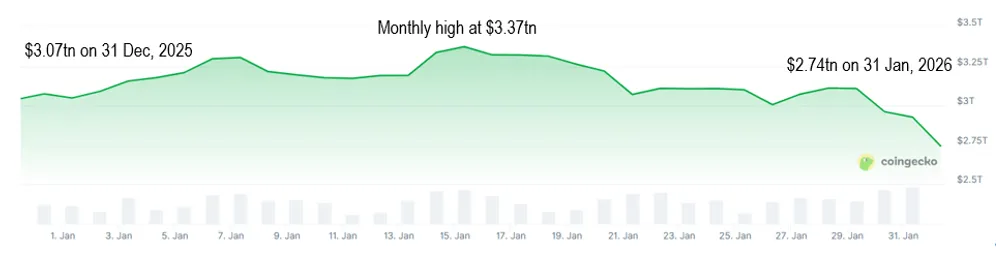
Source: Coingecko, MicroBit, as of 31 January, 2026
The pressure was particularly acute in BTC and major altcoins. Following the announcement of Warsh’s nomination, U.S.-listed spot BTC ETFs recorded a single-day net outflow of more than USD$800m (according to Binance), and BTC fell sharply from USD84,000 to USD78,000, a decline of over 7% in a short window. The move was even more severe across other large-cap tokens: ETH dropped roughly 12%, while SOL declined by about 13%, reflecting both beta amplification and weaker liquidity conditions. The rapid price correction pushed a large cohort of leveraged positions into liquidation territory, triggering forced unwinds on derivatives venues and perpetuating a negative feedback loop of falling prices, shrinking collateral values, and further margin calls.
Figure 2. Net Inflow of the Total US-listed BTC Spot ETFs
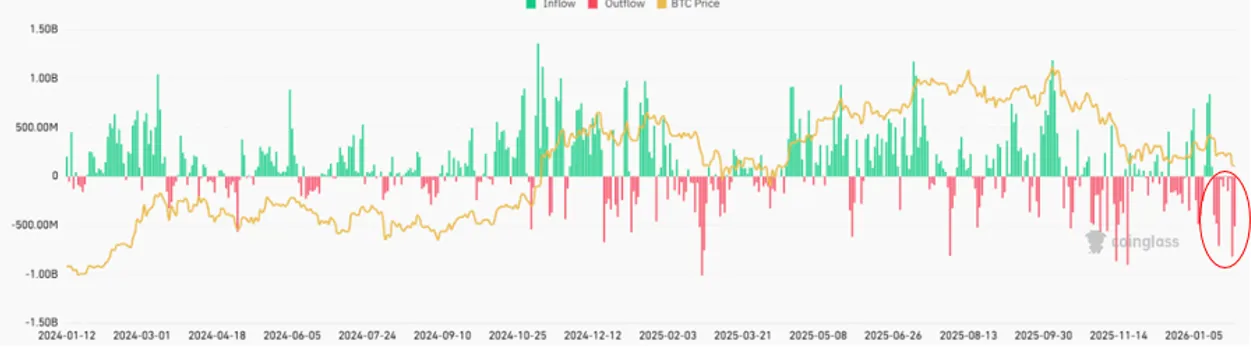
Source: Coinglass, MicroBit, as of 2 February, 2026
Figure 3. BTC Price Change
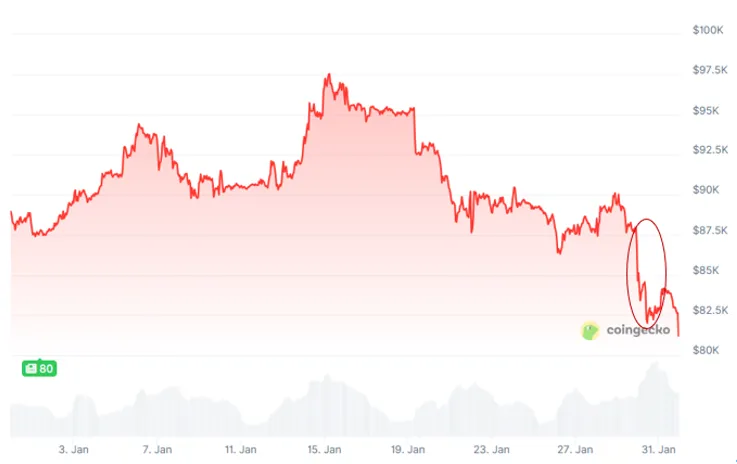
Source: Coingecko, MicroBit, as of 31 January, 2026
Figure 4. ETH Price Change
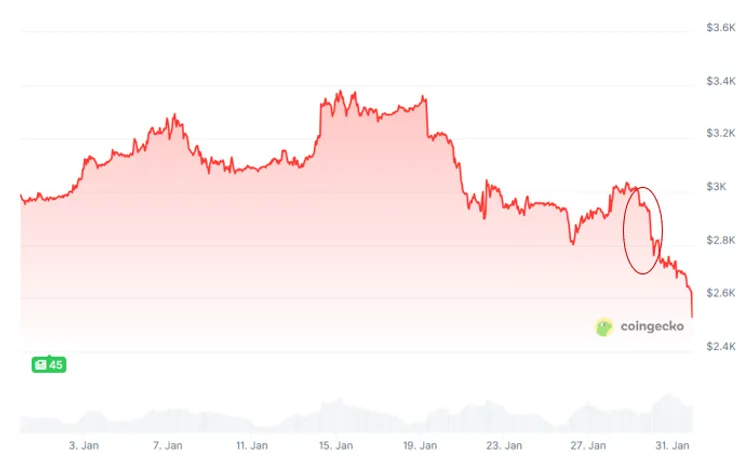
Source: Coingecko, MicroBit, as of 31 January, 2026
This volatility spike and outsized drawdown in BTC have had a pronounced impact on market sentiment. The Crypto Fear & Greed Index has slid into the “extreme fear” zone, indicating a broad capitulation in short-term risk appetite. Beyond geopolitical risks and uncertainty around U.S.–Europe trade and tariffs, the continued delay for Market Structure Bill / Clarity Act in the US has also eroded confidence, making a rapid sentiment recovery unlikely in the near term.
Figure 5. Crypto Fear & Greed Index
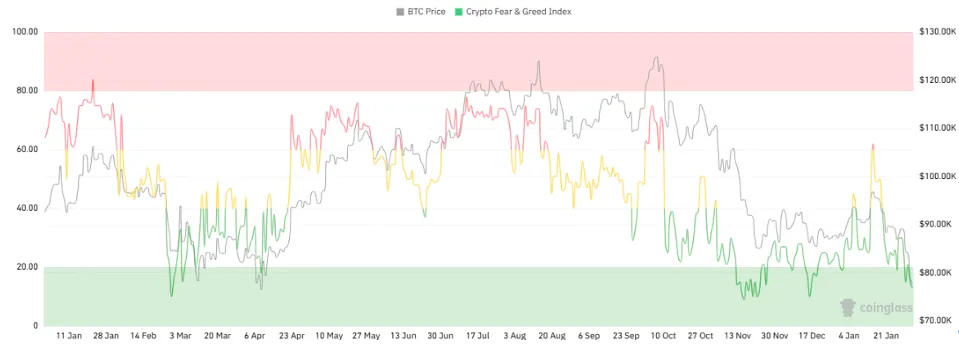
Source: Coinglass, MicroBit, as of 2 January, 2026
Flows in crypto-related ETFs underscore this rotation away from digital assets and toward more traditional hedges. Throughout January, persistent strength in precious metals, combined with the weak performance of cryptocurrencies, drove a steady migration of capital from crypto products into gold and other safe-haven exposures. According to Bloomberg data, the 12 U.S.-listed spot BTC ETFs have now recorded net outflows for three consecutive months, with cumulative redemptions reaching approximately USD$4.8bn over that period, underscoring investors’ preference for perceived stores of value in the current macro backdrop.
Future Outlook
In the current environment of depressed sentiment and bearish dominance, we see this more as a consolidation phase. After four consecutive months of decline, BTC is trading toward the lower end of its recent range, which in our view creates meaningful upside potential once the macro backdrop stabilizes and liquidity conditions improve. More compelling long‑term opportunities are likely to emerge if the regulatory framework becomes clearer and constructive policy or market catalysts begin to unlock liquidity, providing a stronger foundation for renewed strategic allocation into crypto.
Disclaimers
This material is produced by MicroBit Capital Management Limited ("MicroBit") and is intended for Hong Kong investors only. All content is for general information purposes and does not constitute an offer, solicitation, or recommendation to buy or sell any financial instruments, nor is it legal, financial, tax, or investment advice.
Investments involve risks. The value of investments can go up or down, and investors may lose some or all of their invested capital. Past performance is not a guarantee of future results. You should carefully consider your investment objectives and risk tolerance and seek advice from a professional financial advisor before making any investment decisions.
MicroBit does not guarantee the accuracy, timeliness, completeness, or reliability of the information provided. All materials are presented “as is”, without any warranties of any kind, whether express or implied, including but not limited to merchantability, fitness for a particular purpose, or non-infringement. Unless otherwise specified, some of the views and recommendations are compiled by MicroBit based on publicly available data and market experience.
Securities and Futures Commission (SFC) authorization is not a recommendation or endorsement of a scheme, nor does it guarantee its commercial merits or performance. This material has not been reviewed by the SFC.
Copyright © 2026 MicroBit Capital Management Limited. All rights reserved.