"Gold or Bitcoin?" has been an unavoidable question for many over the past few years. The gold camp argues that thousands of years of history, physical backing, and central-bank trust give gold an unshakeable status; the Bitcoin camp counters that its fixed supply, global transferability, and decentralisation make it a "hard asset" better suited to the digital age.
Research suggests that in an environment of rising stock-bond correlations, where traditional diversification tools have become less effective, Bitcoin and gold do not overlap in their sources of risk, safe-haven characteristics, or market-response mechanisms. As portfolio allocations, the two are closer to complementary risk-factor exposures than simple substitutes for one another.[1]
This article compares the fundamental differences between gold and Bitcoin across four dimensions—scarcity, production cost, market structure, and institutional risk—and closes by answering a more practical question: why are both assets worth watching for investors today?
1. Two Scarce Assets: Geological Scarcity vs. Programmatic Scarcity
Gold: Physical Scarcity Set by Geological Constraints
Gold's scarcity comes from nature. The amount of gold in the Earth's crust is extremely limited, and high-grade deposits are becoming increasingly hard to find. Based on data as of 31 December 2025, global mine production reached approximately 3,671.6 tonnes for the year—a record high, yet up only 1% year-on-year, pointing to a marked lack of growth momentum.[2]
This subdued supply growth stems mainly from three factors. First, high-quality gold-mine resources are becoming ever scarcer worldwide, and the exploration and development cycle for new mines continues to lengthen; over the past five years, the number of major new gold discoveries globally has fallen by roughly 40% year-on-year. Second, extraction costs are rising, with continued increases in labour, equipment, and technology spending, prompting some small and mid-sized mines to cut output or halt production because compliance costs have become too high. Third, industry concentration has risen further, with leading producers dominating market supply and limiting overall flexibility.[3]
On the demand side, gold's purchasing power draws on diverse sources, including jewellery, investment (bars, coins, and ETFs), central-bank reserves, and industrial and technology applications. Among these, central-bank buying has been one of the fastest-growing sources of demand in recent years. Amid geopolitical tensions and a broader de-dollarisation trend, central banks in a number of countries have continued to be net buyers of gold. According to the World Gold Council's Q1 2026 estimates, central banks' collective gold-buying target for full-year 2026 remains in the range of 700–900 tonnes.[4]
Constrained supply growth alongside persistently strong and diversified demand provides the real-world underpinning for gold's long-term scarcity.
Bitcoin: Digital Scarcity Enforced by Algorithm
Bitcoin's scarcity comes from code, not geology. When Satoshi Nakamoto designed Bitcoin in 2008, the maximum supply was fixed at 21 million coins, together with a mechanism that halves the block reward roughly every four years (executed in 2012, 2016, 2020, and 2024, respectively). With each halving, the pace of new supply is cut in half, the marginal cost of mining rises, and the supply curve grows progressively steeper.
Beyond this, Bitcoin's scarcity has another dimension. Each bitcoin corresponds to a unique private key, and once that key is permanently lost, the associated supply exits circulation for good—so the number of bitcoin actually available to circulate can only decline over time. As of 20 August 2025, an estimated 2.3 million to 4 million bitcoin (11% to 18% of total issuance) are thought to be permanently inaccessible due to lost private keys.[5]
In recent years, demand has undergone a structural shift. As spot Bitcoin ETFs have been approved in succession in the United States and Hong Kong, institutional investors, family offices, and mainstream wealth-management channels have begun allocating to Bitcoin through ETF products, gradually broadening the demand base from the early retail-speculation phase toward more diversified, institutional-style adoption.
Dimension | Gold | Bitcoin |
Source of scarcity | Geological scarcity; limited mine reserves | Fixed by code; capped at 21 million coins |
Supply growth | Constrained by the mining cycle | Halves every 4 years, trending toward zero |
Predictability | Moderate (affected by exploration and extraction technology) | Relatively transparent and precisely predictable |
Sources of demand | Jewellery, investment, central banks, industrial—highly diversified | Primarily investment and speculation; institutional demand growing rapidly |
Irrecoverable loss | Very low | Lost private keys estimated at 11–18% of total supply |
2. Supply and Market Structure: Gold Mines vs. Mining Rigs
Gold: A Physical Supply Chain and a Mature Market
Gold's journey from mine to bar is a long physical process. A typical gold mine's life cycle unfolds in four stages—exploration (1–10 years), development (1–5 years), production and operation (10–30 years), and closure and rehabilitation (1–5 years)—so the full process often spans more than two decades. Once ore is extracted from underground, it must pass through multiple steps—crushing, grinding, leaching, adsorption, smelting, and refining—before it becomes gold of 99.5% purity or higher.[6]
The key measure of gold-mining economics is the All-in Sustaining Cost (AISC), which captures direct mining costs, processing and smelting charges, sustaining capital expenditure, mine administration costs, environmental rehabilitation provisions, and mining royalties and taxes. In 2025, the global average AISC for gold mining was approximately US$1,578 per ounce[7]. With the gold price above US$3,000, leading producers enjoyed healthy profit margins—yet this also reflects a steadily rising cost floor across the mining industry.
Figure 1: All-in Sustaining Cost (AISC) of Production
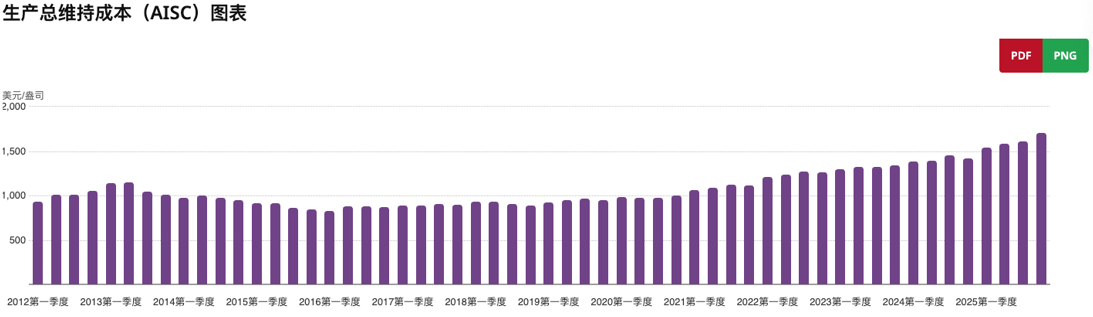
Source: Metals Focus Gold Mine Cost Service; data as of 31 December 2025. For reference only; this does not constitute investment advice.
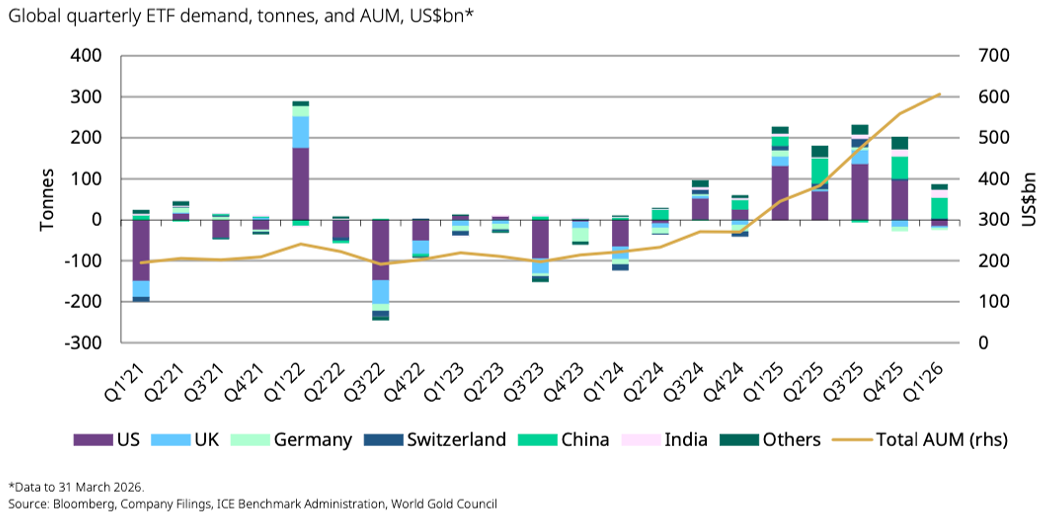
In terms of investment vehicles, gold offers a fairly mature market—ranging from physical bars to gold-mining equities, futures, and structured notes, through to gold ETF products. Notably, Asian investors have visibly increased their gold-ETF allocations since 2024. In 2025, global gold-ETF holdings rose by 801 tonnes to a total of 4,025 tonnes—the second-largest annual increase on record—displaying a "buy-the-rally" pattern in the market.[8]
Figure 2: Global Quarterly Gold-ETF Demand (tonnes) and Assets Under Management (AUM)
Source: World Gold Council, 29 April 2026. For reference only; this does not constitute investment advice.
Bitcoin: Algorithm-Driven Digital Mining
Bitcoin "production," by contrast, relies on computing power. Miners run ASICs (application-specific integrated circuits) to compute hash functions continuously, competing for the right to record the next block; the successful miner earns a Bitcoin reward. The core cost of this process is electricity, which accounts for roughly 60–70% of a mining farm's total operating costs.
According to CoinShares' latest mining report (March 2026), mining costs rose sharply following the fourth halving in April 2024. The cash cost for listed miners to produce a single bitcoin has climbed to nearly US$80,000—up more than 60% from US$49,500 in the third quarter of 2024. At the same time, network hashrate has remained elevated, squeezing miners' margins to an unprecedented degree, with an estimated 15–20% of older-generation rigs now operating at a loss.[9]
In terms of market structure, Bitcoin's price discovery is relatively fragmented, spread across numerous crypto exchanges worldwide, and its liquidity is influenced by derivatives leverage and perpetual futures—so its short-term volatility is markedly higher than gold's. Since the launch of spot Bitcoin ETFs in the United States and Hong Kong, the compliant infrastructure has gradually matured and participation by traditional asset managers has steadily increased, so the market's maturity is catching up at an accelerating pace.
3. Store of Value and Institutional Risk: Which Is Closer to a "Non-Sovereign Asset"?
Gold's Historical Standing and Institutional Evolution
Gold has served as a monetary medium for thousands of years. In the modern era, the 1944 Bretton Woods Agreement established an international monetary system in which the US dollar was pegged to gold and other currencies were pegged to the dollar. In 1971, Nixon ended the dollar's convertibility into gold, and gold formally left the fiat-currency system, entering an era of freely floating pricing.
One key point is often overlooked in this evolution: although gold is itself a non-sovereign asset, most ways of holding it still depend on institutions. The vast majority of retail and institutional investors hold gold through ETFs, paper-gold accounts, or bank custody rather than taking direct possession of the physical metal. These holding methods remain exposed to custodian risk, ETF counterparty risk, and even the risk of sovereign confiscation.
A noteworthy recent development is gold's digital extension: the tokenised-gold market has now surpassed US$5.5 billion in size[10], with gold-backed tokens such as Tether Gold (XAUT) and Paxos Gold (PAXG)[11] allowing investors to hold gold exposure on the blockchain—combining physical backing with digital transferability.
Bitcoin: Decentralised in Theory vs. Re-Centralised in Practice
By design, Bitcoin has non-sovereign characteristics: the protocol itself has no central administrator, and control over the asset is exercised through private keys rather than a single bank account or clearing institution. In technical terms, a holder can initiate a transfer at any time and from any location; the system relies on an open network and consensus mechanism rather than on the operating status of a traditional financial intermediary.
In reality, however, most people still hold Bitcoin through exchanges, custodians, or ETFs—making it, in essence, "decentralised in theory, re-centralised in practice." Exchange risk and changes in regulatory policy constitute Bitcoin's distinctive institutional risks; the nature of the risk simply differs from that of gold.
More noteworthy still is that the two assets' institutional risks are complementary. Physical gold is mainly exposed to risks around storage location, transportation, and physical requisition or seizure; Bitcoin is more exposed to infrastructure risks (such as power-grid failures or cyberattacks), platform custody, and shifts in compliance policy. In extreme scenarios, gold may be more susceptible to physical-control measures, yet it can still be held and traded without any digital infrastructure when power or networks are disrupted. Bitcoin, by contrast—being based on a distributed ledger and private-key control—offers flexibility in how assets are transferred and held that differs from traditional physical assets. For investors, holding both assets at once can help mitigate the "tail risks" of each.
4. An Asset-Allocation Framework: Gold as the Shield, Bitcoin as the Spear
Once you understand the fundamental differences between the two, the question shifts from "which to choose" to "how to combine them."
Low Correlation: The Core Rationale for Portfolio Diversification
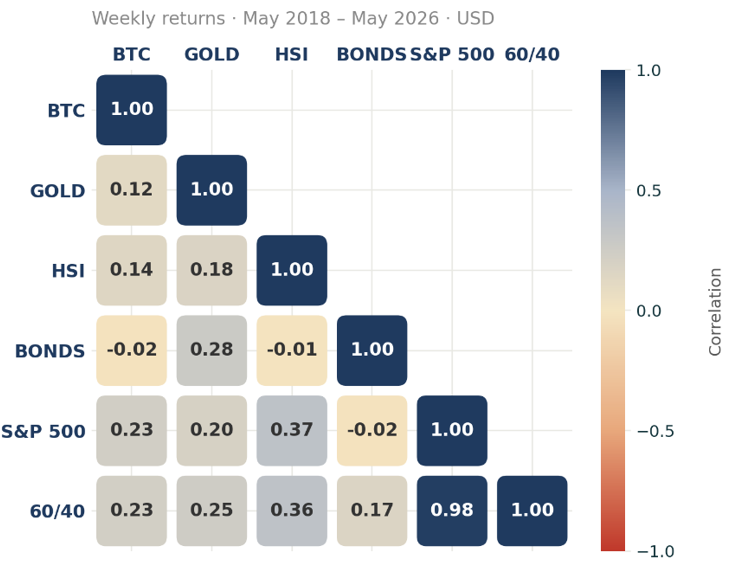
At its heart, asset allocation is about finding low-correlation assets to improve a portfolio's risk-adjusted returns. Gold and Bitcoin stand out on this measure. According to MicroBit's research analysis, from 2018 to mid-2026 the correlation coefficient between Bitcoin and the S&P 500 was 0.23, that between gold and the S&P 500 was 0.20, while the correlation between Bitcoin and gold was just 0.12.[12] Given this low degree of interrelation, a "gold + Bitcoin" combination offers diversification potential beyond that of any single-asset allocation.[13]
Figure 3: Correlation Coefficients Between Assets
For reference only, does not constitute investment advice.
Source: MicroBit, based on Bloomberg data from 30 May 2018 to 30 May 2026.For reference only, does not constitute investment advice.
[1] Source: Kim Oosterlinck, Ariane Reyns & Ariane Szafarz (June 2023), "Gold, Bitcoin, and Portfolio Diversification: Lessons from the Ukrainian War."
[2] Source: Yanjing Bizhi Market Research (研精毕智市场调研), 30 January 2026, 2025–2026 Global Gold Market In-Depth Insights and Strategic Blue Book.
[3] Source: Yanjing Bizhi Market Research (研精毕智市场调研), 30 January 2026, 2025–2026 Global Gold Market In-Depth Insights and Strategic Blue Book.
[4]Source: World Gold Council, 29 April 2026, Gold Demand Trends Q1 2026.
[5] Source: BitGo, 20 August 2025, "Bitcoin's Invisible Burn: Lost Coins Outpace New Supply." Available at: https://www.bitgo.com/resources/blog/bitcoins-invisible-burn-lost-coins-outpace-new-supply/
[6]Source: World Gold Council, 7 May 2018, The Modern Gold Mining Process
[7]Source: Yanjing Bizhi Market Research (研精毕智市场调研), 30 January 2026, 2025–2026 Global Gold Market In-Depth Insights and Strategic Blue Book.
[8]Source: World Gold Council, 29 April 2026, Gold Demand Trends Q1 2026.
[9] Source: CoinShares, 25 March 2026, Bitcoin Mining Report, Q1 2026.
[10] CoinGecko, 13 May 2026, “RWA Report 2026.”
[11]For reference only, does not constitute investment advice.
[12]Source: MicroBit Capital; based on Bloomberg data from 30 May 2018 to 30 May 2026. S&P 500 uses the S&P 500 Total Return Index; Bitcoin uses the Bloomberg Bitcoin Index; Gold uses the LBMA Gold Price PM Fix; Bonds use the Bloomberg US Treasury Total Return Unhedged USD index; 60/40 uses 60% S&P 500 / 40% Bonds; HSI uses the Hang Seng Index.
[13]Harry Markowitz, 1952-3, The Journal of Finance.
Investment involves risks. Past performance does not represent future performance. The price of the fund may go up or down. Investors may suffer all or significant investment losses. Investors should not make any investment decisions solely based on this information. Please note that the investment risks listed below are not exhaustive. Investors should carefully read the prospectus, product key factsheet and relevant documents before making any investment decisions to understand details including product characteristics, risk factors and distribution policies, and seek for independent financial advice when necessary.
· MicroBit Bitcoin Spot ETF (the “Sub-Fund”) is a sub-fund of MicroBit Funds Series (Hong Kong) ETF OFC (the “Company”). The investment objective of the Sub-Fund is to aim to provide investment results that, before fees and expenses, closely correspond to the performance of the price of bitcoin as reflected by CME CF Bitcoin Reference Rate – Asia Pacific Variant (the “Index”) by directly investing in bitcoin on SFC-Licensed VATPs. There can be no assurance that the Sub-Fund will achieve its investment objective.
· MicroBit Bitcoin Spot ETF could be subject to certain key risks such as Investment risk; Risks relating to bitcoin (including Bitcoin and bitcoin industry risk, Speculative nature risk, Extremely high volatility risk, Unforeseeable risk, Acceptance of bitcoin, Concentration of ownership risk, Fraud, market manipulation and security failure risk, Cybersecurity risks, Potential manipulation of Bitcoin Network risk, Regulatory risk, Internet risk, Fork risk, Virtual Assets’ trading platform risk in general and contagion risk, Risk of illicit use, Environment and energy consumption risk, Political or economic crisis risk, etc.); New product risk; Passive investment management risk; Risks in relation to Virtual Asset Trading Platform(s); Custody risk; Risks relating to the Index; Concentration risk; Tracking error risk; Trading hours differences risk; Trading risk; Reliance on market makers risk; Early termination risk; Multi-counter risk.
· The above products have been authorized by the Securities and Futures Commission (“SFC”). Authorization by the SFC does not imply official recommendation. This material is for reference only and does not constitute an offer or suggestion of any transaction in any products.
· This material is prepared by MicroBit Capital Management Limited and has not been reviewed by the SFC. If you are in any doubt about the content of this material, please refer to the prospectus, product key facts statement and other relevant documents for details, and seek for independent financial advice when necessary.
· The content contains several pieces of information compiled from third-party sources. MicroBit Capital Management Limited has made every effort to ensure that this data is accurate, complete, and up to date, and has taken verification measures to accurately reproduce the relevant information. However, MicroBit Capital Management Limited assumes no responsibility or liability for the accuracy of this information, its use, or reliance upon it. This content may include forward-looking statements based on MicroBit Capital Management Limited 's opinions, expectations, and assumptions. MicroBit Capital Management Limited has no obligation to update or revise any forward-looking statements, and actual results may differ significantly from those anticipated in the forward-looking statements. All copyrights to the content of this material, including all data, images, computer code, text, logos, and designs, are owned by MicroBit Capital Management Limited. The information provided in this content may not be copied or distributed without the consent of MicroBit Capital Management Limited.