
In May 2026, the cryptocurrency market entered a broader consolidation phase as virtual assets came under pressure from a more challenging macro backdrop. U.S. inflation remained sticky, with April core PCE rising 3.3% year-on-year, while revised first-quarter U.S. GDP growth slowed to 1.6%, reinforcing a less favourable combination of persistent price pressure and softer growth. Geopolitical tensions kept energy markets sensitive and pushed oil prices higher, raising concerns that energy cost pressures could feed back into headline inflation and further complicate the path of monetary easing. Against this backdrop, investors grew increasingly cautious that central banks, particularly the Federal Reserve, may have limited scope to ease policy meaningfully in the near term.
Financial conditions, therefore, remained relatively tight, reducing support for higher-beta assets, including cryptocurrencies. Bitcoin and Ether both traded with a more defensive tone through the month.
Market Performance Overview: Recovery continues as sentiment turns more rational
In May, total crypto market capitalisation remained relatively resilient, extending the recovery that began in early April before consolidating toward the upper end of its recent range by month-end. The shape of the move was characterised more by a gradual grind higher, suggesting a constructive backdrop supported by incremental inflows and improving risk sentiment rather than outright euphoria. Despite some late-month softening, the market remained above its early-April base, indicating that profit-taking has so far been orderly and that the broader recovery in digital assets has not been materially disrupted.
Figure 1. Crypto Market Cap in May 2026
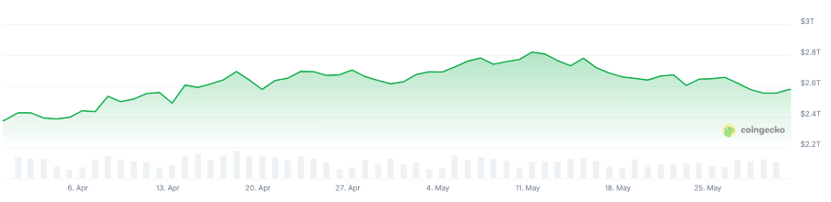
Source: Coingecko , as of 31 May, 2026. For reference only, does not constitute any investment recommendation.
In May 2026, Bitcoin went through a mid-cycle shakeout, with spot easing from early-month levels near 80,000 to roughly 70,000 by month-end. The move lower was marked by a steady pattern of lower highs, as earlier ETF-related optimism, crowded positioning, and stretched valuations met a firmer U.S. dollar and ongoing macro uncertainty. In our view, this orderly pullback, following the strong gains in April, is better interpreted as a healthy consolidation phase than the start of a new bear leg, helping to flush out leverage, normalise sentiment, and create more attractive entry levels for adding to high-conviction Bitcoin exposure over a medium-term horizon.
Figure 2. BTC Monthly Return
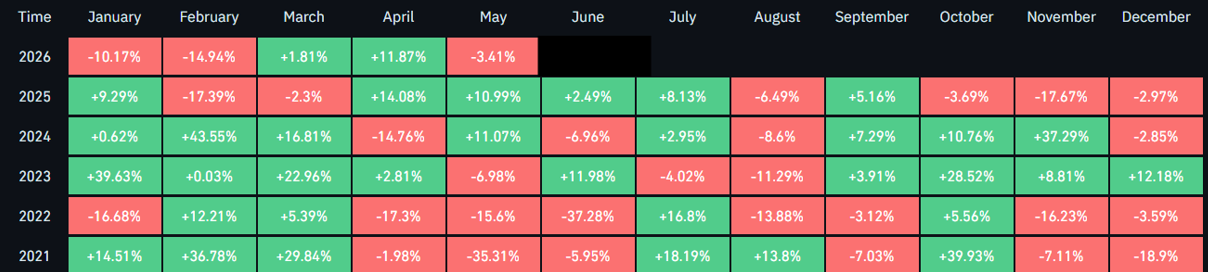
Source: Coinglass, as of 31 May, 2026. Investment involves risks. Past performance does not represent future performance.
Figure 3. BTC Price Change
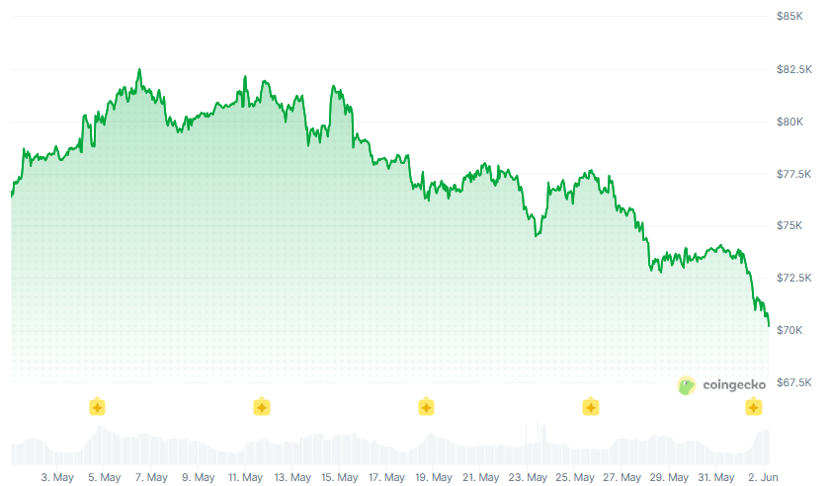
Source: Coingecko, as of 31 May, 2026. Investment involves risks. Past performance does not represent future performance.
Ether lagged behind Bitcoin in May, underscoring a more measured tone beneath the broader crypto market. While both assets moved lower over the month, Ethereum’s sharper pullback suggests that investors continued to favor Bitcoin’s greater liquidity, stronger institutional support, and more defensive positioning within digital assets. This relative divergence is consistent with a market that was consolidating rather than turning fully risk-off, with capital remaining in the asset class but rotating toward higher-quality large-cap exposure.
Figure 4. ETH Price Change
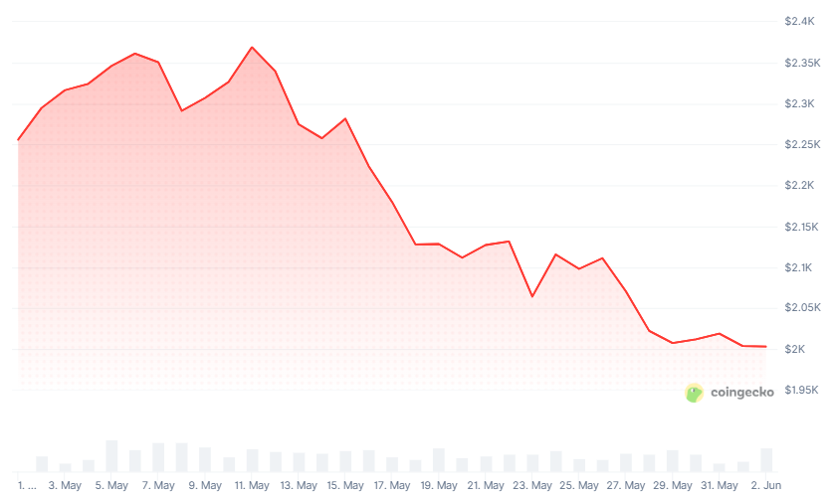
Source: Coingecko, , as of 31 May, 2026. Investment involves risks. Past performance does not represent future performance.
The Crypto Fear & Greed Index drifted lower from mid-May level of 50 through May to end at 27 by end of May, reinforcing the view that the month’s price weakness was accompanied by a meaningful deterioration in short-term risk appetite rather than a purely technical pullback. From a positioning perspective, the shift away from neutral sentiment toward a more cautious stance suggests that investors became increasingly selective as upside momentum faded, with capital rotating toward higher-quality exposures and overall risk appetite moderated across the broader digital asset complex. In our view, this moderation in sentiment is constructive from a medium-term perspective, as it helps unwind excess optimism, reduce crowded positioning, and create a healthier backdrop for subsequent re-risking.
Figure 5. Crypto Fear & Greed Index
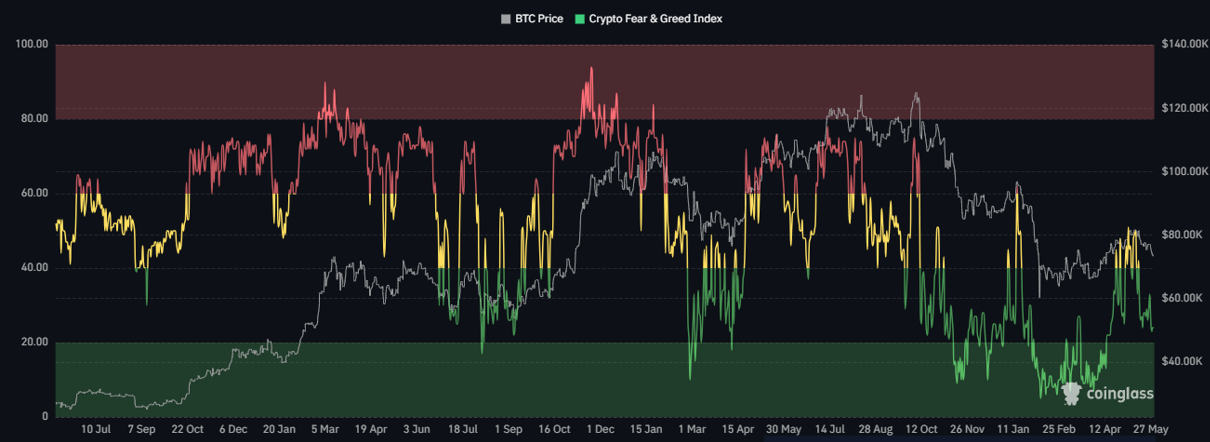
Source: Coinglass, as of 31 May, 2026. For reference only, does not constitute any investment recommendation.
Total BTC spot ETF flows [1] softened meaningfully in May 2026, with sustained outflows emerging as Bitcoin lost momentum and investors pulled back from adding risk after the earlier rally. U.S. spot Bitcoin ETFs also posted 10 consecutive trading days of net outflows, with roughly US$2.9 billion to US$3.0 billion redeemed since mid-May, reinforcing the view that ETF demand, which had previously acted as an important source of support for spot prices, became materially less dependable over the month. In our view, this deterioration in flows points more to a pause in institutional momentum than to any change in the longer-term adoption story, and we would interpret this phase of outflows as part of a broader positioning reset following a period of strong performance.
Figure 6. Total BTC Spot ETFs Net Inflow [1]
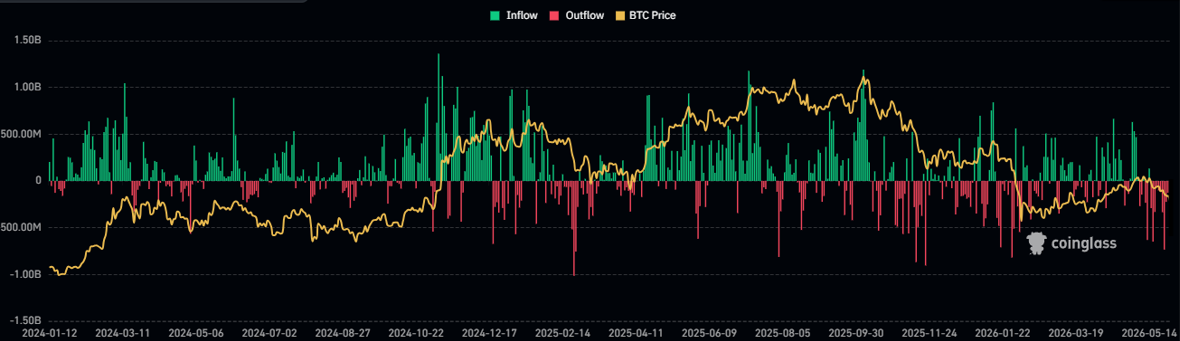
Source: Coinglass, as of 31 May, 2026. For reference only, does not constitute any investment recommendation.
[1] Net Inflow of total BTC Spot ETFs listed in the US.
Future outlook
Looking ahead, markets remain sensitive to the risk of inflation reaccelerating, particularly if firmer energy prices feed through into broader price pressures and keep bond yields elevated. In May, the U.S. 10-year Treasury yield rose to 4.68%, while the 30-year Treasury yield reached 5.2% in mid-May, its highest level since July 2007, underscoring the risk that financial conditions may stay tighter for longer and continue to weigh on rate-sensitive assets, including virtual assets. At the same time, as major equity indices remain strong and technology-led markets continue to outperform on AI-driven optimism, a larger share of global risk capital is likely to be drawn toward traditional equity markets. Nevertheless, if Bitcoin were to retrace toward the lower end of its recent range, we would view that as a more attractive level for gradual accumulation on a phased basis.
Disclaimers
This material is produced by MicroBit Capital Management Limited ("MicroBit") and is intended for Hong Kong investors only. All content is for general information purposes and does not constitute an offer, solicitation, or recommendation to buy or sell any financial instruments, nor is it legal, financial, tax, or investment advice.
Investments involve risks. The value of investments can go up or down, and investors may lose some or all of their invested capital. Past performance is not a guarantee of future results. You should carefully consider your investment objectives and risk tolerance and seek advice from a professional financial advisor before making any investment decisions.
MicroBit does not guarantee the accuracy, timeliness, completeness, or reliability of the information provided. All materials are presented “as is”, without any warranties of any kind, whether express or implied, including but not limited to merchantability, fitness for a particular purpose, or non-infringement. Unless otherwise specified, some of the views and recommendations are compiled by MicroBit based on publicly available data and market experience.
Securities and Futures Commission (SFC) authorization is not a recommendation or endorsement of a scheme, nor does it guarantee its commercial merits or performance. This material has not been reviewed by the SFC.
Copyright © 2026 MicroBit Capital Management Limited. All rights reserved.