
Macro and policy: temporary pause but tightening stance remains
The FOMC left Fed Fund rates unchanged on 28 October in a 10–2 split, with Governor Lisa Cook and Cleveland Fed President Beth Hammack dissenting in favour of an immediate 25bp increase. Reading the pause as the end of tightening would premature. Chairman Warsh used the press conference to acknowledge that financial and credit conditions had tightened for some businesses and households “much as we would expect”, but declined to call the condition restrictive, leaving room of for interpretation regarding future policies. With September CPI at 3.7%, the FOMC was likely only taking a pause to make further observation before making another move. At the latest data, market expects approximately 90% probabilities of rate increase in December.
Treasury yields moved down for the month. The 10-year Treasury yield fell from 5.30% down to around 4.93% at month end. With the front end still yielding 4%, real yields remain a binding constraint on non-yielding assets, such as gold and crypto.
Energy was up quite strongly in October but by the time of report subsequently reversed its gains in November. Brent crude reached near US$118 a barrel and WTI near US$105 in October, both recorded gains in the 14% to 15% range. Higher crude oils prices, despite the short-term pull-back, feed directly into inflation, and in turn influence the Federal Reserve’s interest rate policies going forward.
Crypto Market Performance Overview
October 2026 was a weak month, both for equities such as tech stocks as well as for crypto assets. Total crypto market capitalisation opened the month just below US$3.0 trillion, edged above it in the first week, then ground steadily lower to finish in the mid-US$2.7 trillion area, very much in line with the move of Bitcoin.
The drawdown was concentrated in the final week of the month and coincided with the Binance hack event rather than any macro release, which suggests that sellers were responding to asset-security risk rather than rates and yields.
Figure 1. Crypto Market Cap in October 2026
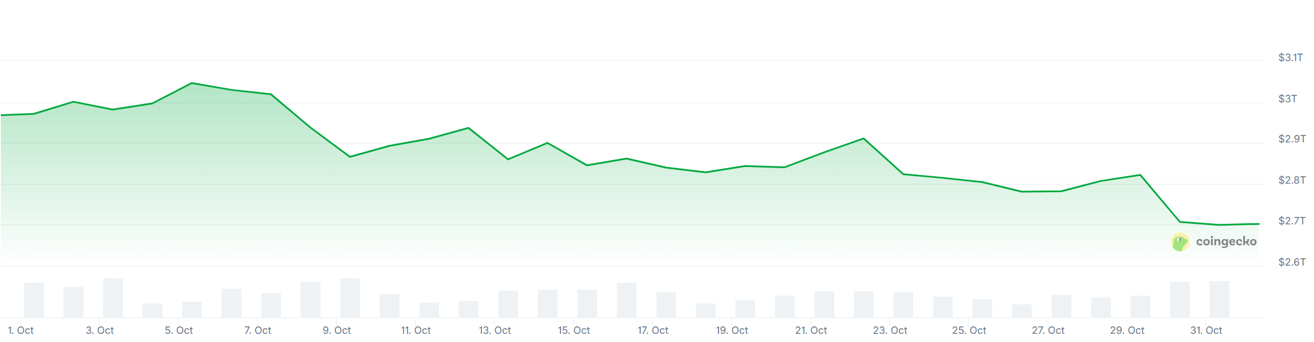
Source: CoinGecko, as of 31 October 2026. For reference only, does not constitute any investment recommendation.
Bitcoin closed October lower, fully erased all gains in September. Concerns with tightening outlook and an exchange security failure led to the correction in October. The month opened in the low-US$80,000s and made an intra-month high in the first week, before going on a staircase decline. Repeated attempts to hold the low-US$80,000s failed, and from middle of the month onwards the market was fluctuating between US$79,000 and US$80,000s. Finally, the biggest drop came at the final days of the month, when price fell through US$80,000 level decisively. Prices continued to fall towards the next support level, which appeared to be in the 75,000-77,000 range, the previous intra-month bottom in September. Turnover on last few days, when the security breach happened, was well above the preceding weeks, which indicated that the move was institutional liquidation driven rather than retail investor noise.
The trigger was not as much macro economy related this time. At the end of October, Binance disclosed a security breach purportedly linked to North Korean hackers. It was reported that 18,270 Bitcoins were stolen, estimated to worth up to US$ 1.4 billion. Blockchain investigators estimated that including other crypto assets, total value stolen was more than US$6 billion, the largest theft in crypto history. The crypto-hack news sent the entire crypto block into sharp correction, though Binance eventually announced that all stolen assets were insured and investors were compensated adequately.
Deleveraging was also a major factor. A large volume of futures positions was liquidated in the 24 hours around the breach, with Bitcoin and Ether accounting for the bulk and longs the large majority. Aggregate open interest fell through the same window, the signature of forced reduction rather than fresh shorting. The deleveraging results in a less crowded market.
In terms of technical analysis, the trend has deteriorated. The September golden cross we flagged as a possible momentum reversal has been invalidated, and the breach of the US$80,000 support means the September and even the June lows will be next levels.
Figure 2. BTC Monthly Return
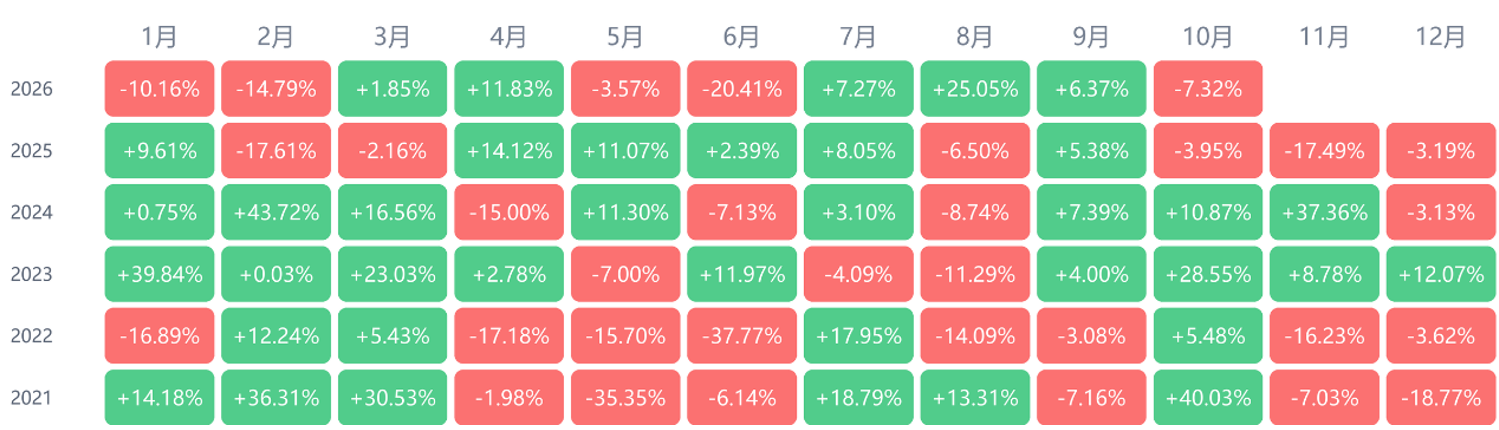
Source: Coinglass, as of 31 October 2026. Investment involves risks. Past performance does not represent future performance.
Figure 3. BTC Price Change
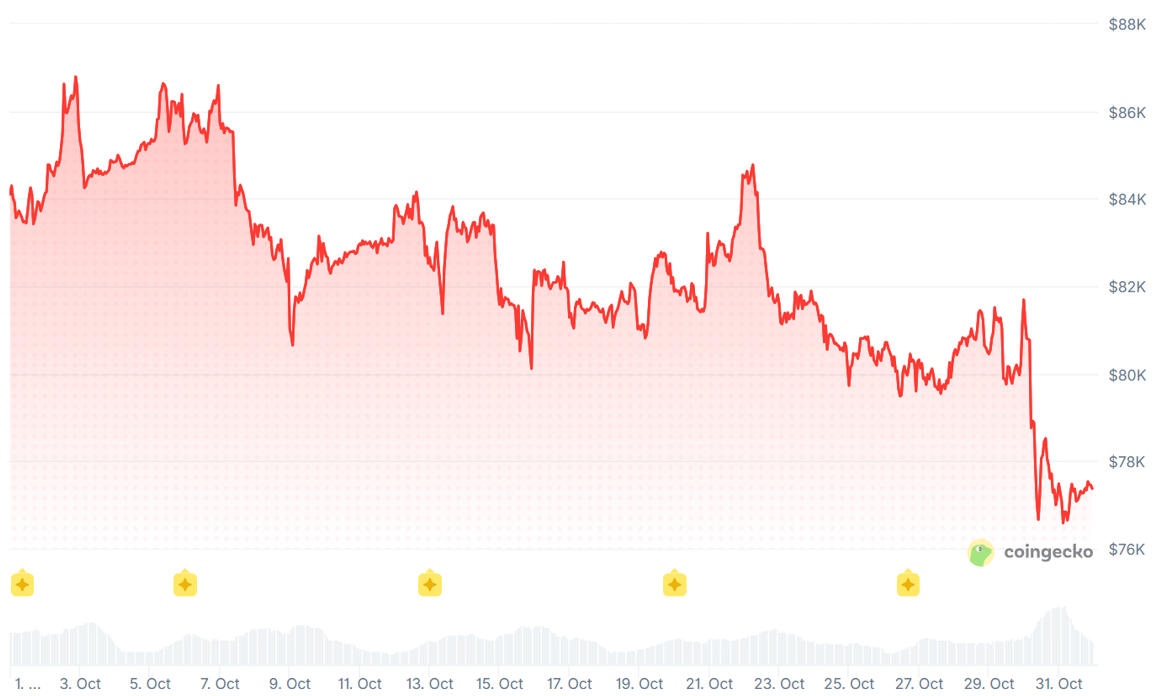
Source: CoinGecko, as of 31 October 2026. Investment involves risks. Past performance does not represent future performance.
Ether fared considerably worse. It opened the month in the high-US$2,600s, made a brief push above US$2,700 in the first week, fell below the US$2,500 level in the second week and never reclaimed. Eventually it closed the month slightly above US$2,200, already lower than the September lows, and a visibly deeper decline than Bitcoin during the month.
The weakness was flow-led as much as price-led. US spot Ether ETFs were in net redemption on every session of the closing stretch, the longest such run since launch, and the month ended in record outflow of more than $1.6 billion!
Figure 4. ETH Price Change
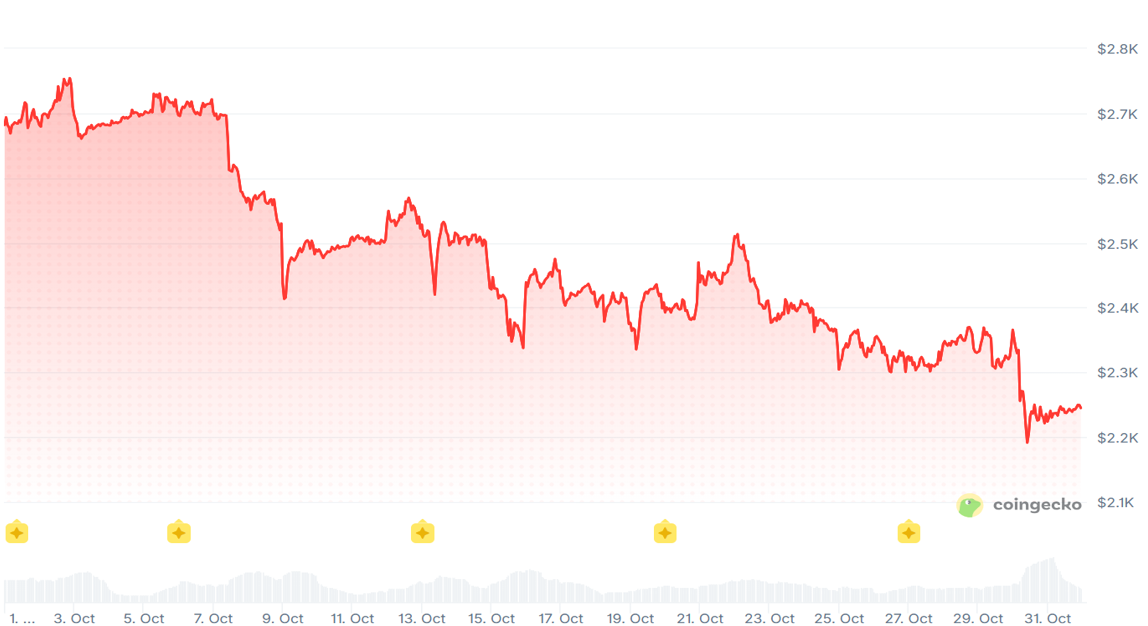
Source: CoinGecko, as of 31 October 2026. Investment involves risks. Past performance does not represent future performance.
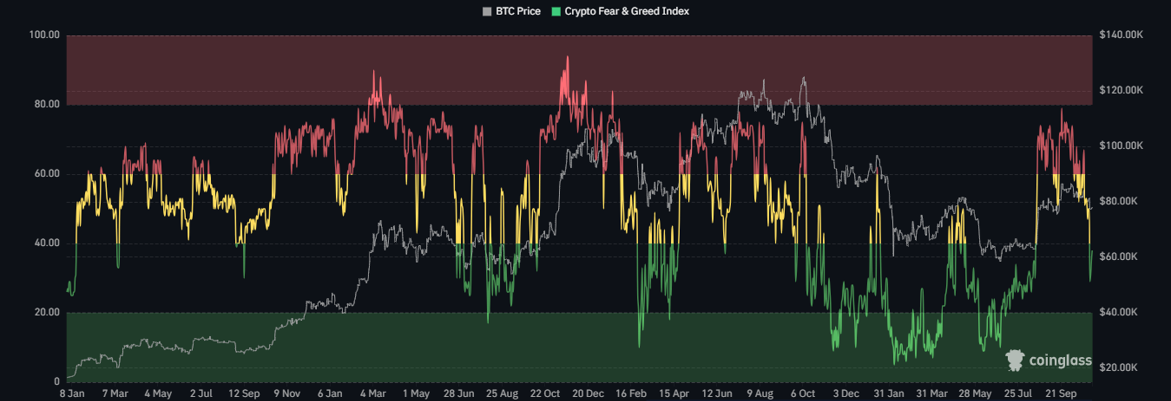
The Crypto Fear & Greed Index tracked moved from greed level to fear level all within one month, one of the sharper sentiment reversals of the year as well as in recent memory. It started in greed territory as momentum from September carried over, slipped to neutral on a downward staircase path, and plunged into fear level at the end of the month on the Binance exchange security breach news (reading of 31 as of 31 October 2026). On previous occasions where the index had fallen from greed level to fear level within one month, price more likely than not further lowered the following month, though the empirical observation is based on small sample size.
The month of October ending in fear level was less encouraging than the September reading, when sentiment held through a drawdown. Flow data pointed to investor de-leveraging, but allocation was not abandoned entirely.
Figure 5. Crypto Fear & Greed Index
Source: Coinglass, as of 31 October 2026. For reference only, does not constitute any investment recommendation.
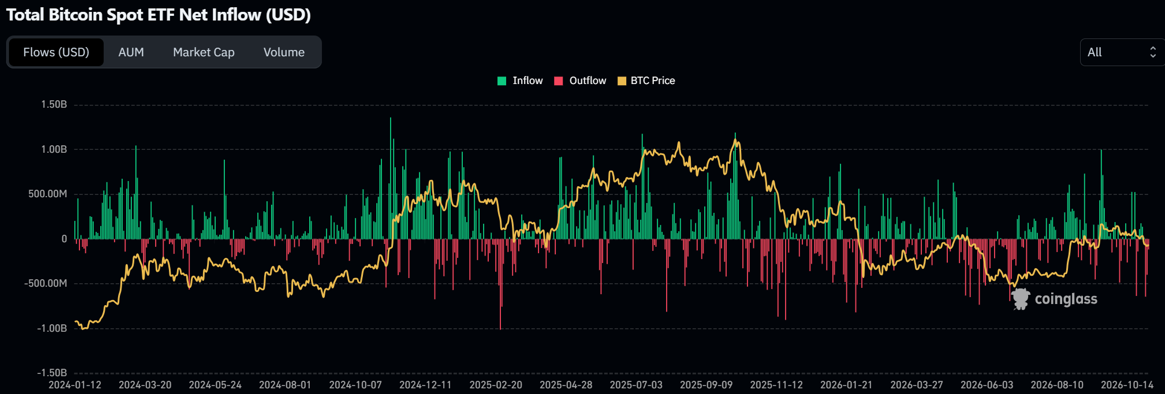
Bitcoin spot ETF flows started the month began with inflows, held through the middle of the month, then turned hard into outflows on 30 October on news of the Binance event. The outflow was the largest single day outflow since June, and the full month closed in net redemption.
Figure 6. Total BTC Spot ETFs Net Inflow [1]
Source: Coinglass, as of 31 October 2026. For reference only, does not constitute any investment recommendation.
[1] Net Inflow of total BTC Spot ETFs listed in the US.
Gold Market Performance Overview
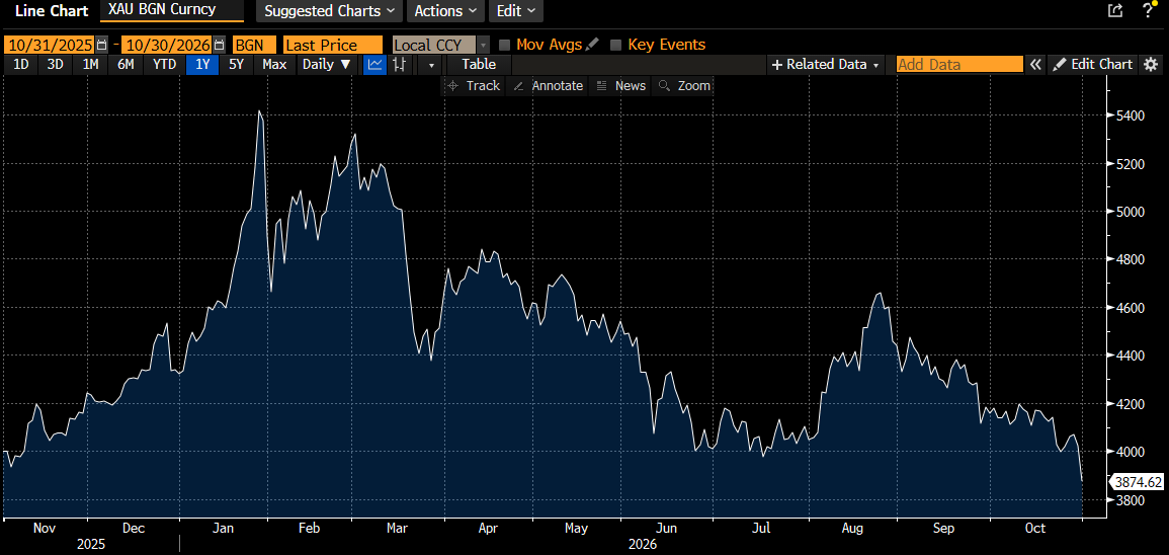
Gold closed October materially lower, a second consecutive monthly decline, closing the month below US$3,900 level, reaching a year-to-date as well as a 12-month low.
In the international geopolitical side, various events related to Saudi Aribia, Iran, Russia, etc. all added fire to geopolitical tension. As mentioned earlier, the fact that oil prices were rising for 4 consecutive months did not do gold prices any favours. With inflation concerns overwhelming the market, gold prices were constantly under pressure for the month.
Federal Reserve held rates unchanged in Oct, but 2 members dissenting from the majority decision in favour of rate hikes in the Oct meeting. The dissenting votes shifted market expectations about next meeting in December. Latest Fed Fund watch also pointed to probability of 90% for a 25bps rate hike.
Figure 7. Gold price change
Source: Bloomberg, as of 31 October 2026. Investment involves risks. Past performance does not represent future performance.
Outlook
Crypto Market
For crypto assets, the hacking event of Binance as well as overall investor concerns regarding over-spending in AI sector weighed down Bitcoin and others alike. Concerns about a Democrats controlled Congress would restrict AI development also led to corrections across the board, including crypto assets. With the previous support level around US$ 80,000 clearly fallen through, the next support level appeared to be in the 60,000-65,000 range, where Bitcoin previously bottomed in June. Without near term positive catalysts in the sector, downward momentum expected to persist as investors turned risk-off and fled back to other perceived safer traditional assets such as US Treasuries.
Gold
Influence from oil prices is still the key. High crude oil prices in October, led to higher real rates, and lower gold price. Central banks’ demand and reserve diversification have not reversed, providing a structural floor for gold prices.
With Democrats winning control for both House and Senate, market foresees more checks on President Trump’s policies, specifically the Middle East policies, where President Trump would be forced to take less drastic actions towards the Middle East. Thus, the prediction of de-escalation in Middle East tension leads to lower oil prices after the election, which in turn lowers inflation outlook, lowers further rate hike probabilities, and supports gold prices.
De-escalation in Middle East, and the potential ceasefire leaves two conditional paths. A ceasefire that holds would reverse much of this year’s crude gain, reopen the case for lower rates and boost gold prices. A ceasefire that fails would re-ignite oil surge, impose rate pressure through inflation expectations, real yields rise, and gold would be under pressure once again.
We maintain our view that US$ 3800-4,000 would be the immediate support line, followed by the next strong support level at US$ 3,300-3500, the zone where gold prices spend most of 1H2025 before the rally that started in 2H2025.
Supplementary: The Midterm results read through
The elections produced a “Blue Wave” where the margin of the win, not the direction, surprised many. As widely expected, before the mid-term elections, Democrats won control of the House. Democrats have at least 255 seats, already well past the 218 seats needed for majority, with counting still unfinished in some districts. What is a bit more surprising is how strong the Democrats performed at the Senate, where before the election there was only a 60% chance of them winning control of Senate according to survey. In the election, Democrats took control of the Senate with 55 seats to Republican having 44 seats, flipping Texas, Kansas, Iowa, Ohio, South Carolina, North Carolina, Maine, and Mississippi (results in Alaska still undetermined).
In terms of domestic policies, Democrats would likely emphasize on social welfare such as medical, education, child support, etc. Those programs will likely add to the fiscal deficit that is already running high. A fiscal expansion, a wider deficit and a higher term premium would theoretically push long term rates up. As for international policies, a Democrat controlled Congress can apply more checks on President Trump, specifically his Middle East policies, where President Trump would likely be forced to take less drastic actions towards the Middle East opponents such as Iran.
For the equities market, we may have to reevaluate the level of bearishness currently persists towards both AI and semiconductor players. While the market initially welcomed a Democrat controlled Congress on the first day following the election, AI and semiconductor sectors took a huge plunge on the second day after the election. For the fact that the Democrats policies are generally less accommodating towards AI and datacenters, market views quickly evolved into negative concerns that Democrats will put a halt to AI related investments. Furthermore, several elected Democrat officials were calling for datacenter constructions to be stopped following their election victories. For instance, Texas Governor-elect Gina Hinojosa called for an immediate halt of datacenter constructions in Texas, as well as eliminating tax incentives related to data centers in the state. Companies such as Tesla, Google, Meta, Oracle and OpenAI had all made significant investments in data centers in Texas.
On the other hand, a contrarian argument can be made that Texas and other states calling for a halt in datacenter construction is exactly the solution to the negative cash flow problem of tech giants such as Meta and Google. A government-ordered construction halt could potentially help the tech giants to conserve cashflow and re-allocate the cash to other profit enhancing projects.
Elsewhere in global equities markets, Hong Kong, onshore China, and India continued to show resilience against global adjustments. Our assumption of global fund allocations shifting away from the US market may continue. The 3 markets in HK, China, and India could be good buying targets towards the end of the year.
For crypto assets, the post-election correction was driven by policy outlook instead of crypto asset specific. In a vacuum, crypto has no independent political beta: it has no legislative catalyst to lose and no fiscal appropriations to gain. On the other hand, whether policies will be accommodating towards the crypto assets, will very much affect sentiment outlook. We see much lower probabilities that a Democrat controlled Congress would pass any bills favourable to crypto assets. On the other hand, the pro-regulation stance by Democrats may in turn push the SEC or other regulatory bodies to provide more definitions and rules that might be beneficial for long term development. However, market is still not believing those to be positive in the near term. Moreover, corrections in US equities and in particular AI and tech related sectors have some spillover effects into crypto markets. As a result, investors are still risk-off, and funds are flowing back to traditional assets such as US Treasuries.
Falling oil prices resulting from US midterm elections also influence inflation and interest rates outlook. A Democrat controlled Congress is expected to rein in President Trump’s aggressive overseas policies. Oil price retreated in anticipation of lower geopolitical tension in Middle East for the next 2 years, the remaining of President Trump’s term. In the first week after the election, ICE Brent Crude was down 17% and NYMEX Light Crude was down 13%.
Gold prices may act in the opposite direction. With oil prices finally topping off, inflation expectations in turn can finally take a pause. However, as written mentioned, many uncertainties remain for gold prices. While we believe softer inflation expectation is an initial boost to gold, interpretations and outlook from midterm election varied rapidly on a day-to-day basis. Volatilities are expected to continue.
This material is produced by MicroBit Capital Management Limited ("MicroBit") and is intended for Hong Kong investors only. All content is for general information purposes and does not constitute an offer, solicitation, or recommendation to buy or sell any financial instruments, nor is it legal, financial, tax, or investment advice.
Investments involve risks. The value of investments can go up or down, and investors may lose some or all of their invested capital. Past performance is not a guarantee of future results. You should carefully consider your investment objectives and risk tolerance and seek advice from a professional financial advisor before making any investment decisions.
MicroBit does not guarantee the accuracy, timeliness, completeness, or reliability of the information provided. All materials are presented “as is”, without any warranties of any kind, whether express or implied, including but not limited to merchantability, fitness for a particular purpose, or non-infringement. Unless otherwise specified, some of the views and recommendations are compiled by MicroBit based on publicly available data and market experience.
Securities and Futures Commission (SFC) authorization is not a recommendation or endorsement of a scheme, nor does it guarantee its commercial merits or performance. This material has not been reviewed by the SFC.
Copyright © 2026 MicroBit Capital Management Limited. All rights reserved.