Global financial markets delivered a mixed but broadly resilient performance in August 2026, supported by technology-sector strength and selective risk appetite but increasingly constrained by elevated bond yields, inflation concerns and geopolitical uncertainty. A key development came on 19 August, when the US Treasury announced it would double the maximum size of liquidity-support buybacks for older long-dated nominal Treasury securities from US$2 billion to at least US$4 billion per operation, temporarily easing pressure on long-term yields while underscoring concerns over Treasury-market liquidity and government borrowing. Meanwhile, oil prices recovered to around US$89 per barrel, adding to inflation concerns and keeping investors focused on incoming macroeconomic data. At the Jackson Hole symposium, Fed Chair Kevin Warsh reiterated that the Federal Reserve would have “work to do” if inflation did not show a convincing return towards its 2% target, reinforcing expectations that the Fed could maintain a restrictive policy stance or potentially raise rates in September.
Crypto Market Performance Overview
Crypto markets recorded a strong recovery in August 2026, with total market capitalization rising from approximately US$2.2 trillion at the start of the month to around US$2.7 trillion at month-end. This represents an increase of roughly US$500 billion, or about 23%, over the period.
Figure 1. Crypto Market Cap in August 2026
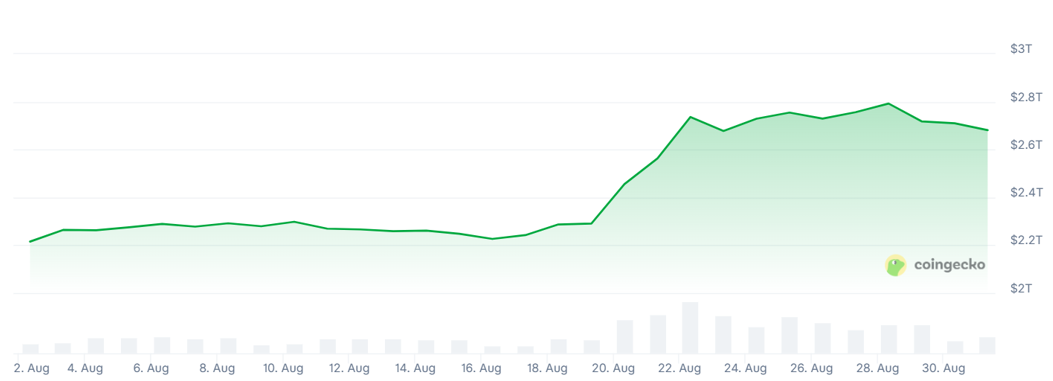
Source: Coingecko, as of 31 August 2026. For reference only, does not constitute any investment recommendation.
Bitcoin’s market sentiment improved materially during the third quarter following a challenging first half of 2026, when the asset recorded monthly declines in January, February, May and June. After gaining 7.36% in July, Bitcoin extended its recovery with a 24.95% increase in August, reflecting renewed investor interest and a marked improvement in market momentum.
Bitcoin started August at approximately US$63,000 and traded largely within a narrow US$62,500–65,000 range during the first half of the month. Momentum strengthened decisively in the second half of August. Bitcoin broke above US$70,000 around 20 August and subsequently rallied toward the US$77,000–78,000 range, underpinned by stronger buying interest and improving risk appetite across the digital-asset market.
Figure 2. BTC Monthly Return
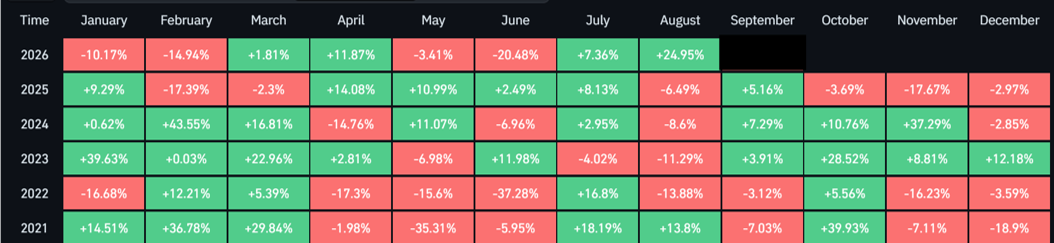
Source: Coinglass, as of 31 August 2026. Investment involves risks. Past performance does not represent future performance.
Figure 3. BTC Price Change
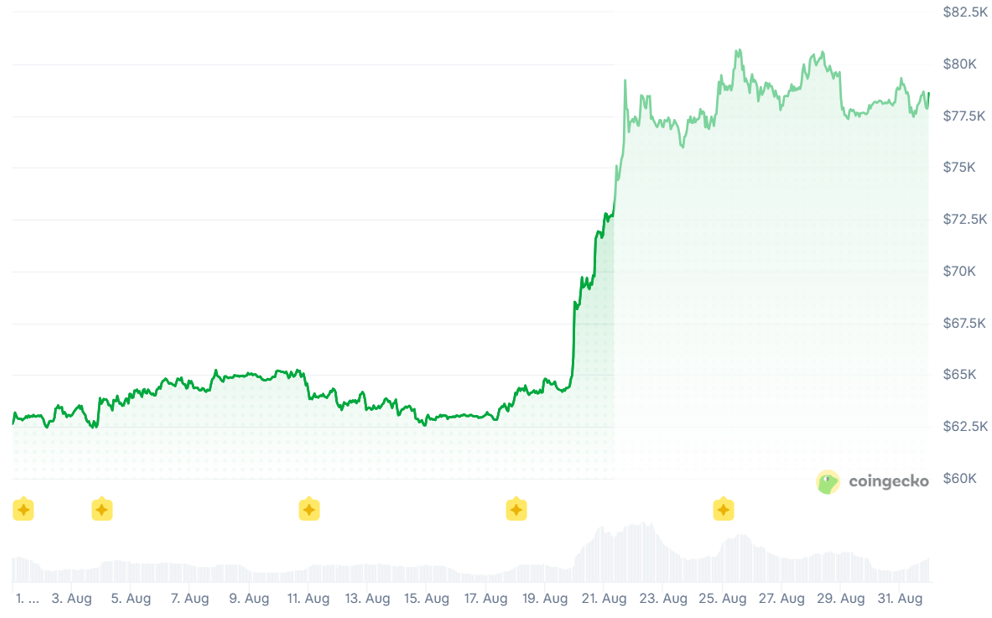
Source: Coingecko, as of 31 August 2026. Investment involves risks. Past performance does not represent future performance.
Ether performed strongly in August 2026, rising from approximately US$1,860 at the beginning of the month to around US$2,460 at month-end, representing a gain of roughly 32%. After trading largely sideways between US$1,850 and US$1,920 during the first half of August, Ether rallied sharply from around 20 August, breaking above US$2,000 and subsequently reaching an intramonth high near US$2,530. Although it experienced some volatility and modest profit-taking late in the month, Ether remained above US$2,400 by month-end, indicating sustained investor demand and improved sentiment across the digital-asset market.
Figure 4. ETH Price Change
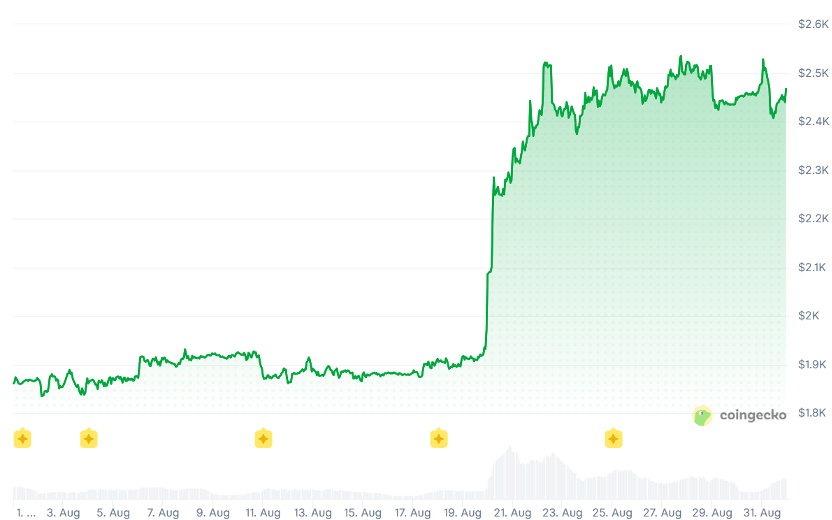
Source: Coingecko, as of 31 August 2026. Investment involves risks. Past performance does not represent future performance.
The Crypto Fear & Greed Index improved notably in late August, rising from the fear range earlier in the month to above 70, which indicates a return to greed among digital-asset investors. The improvement in sentiment coincided with Bitcoin’s rally toward the US$62,000–81,000 range, suggesting that stronger price momentum encouraged renewed risk-taking across the cryptocurrency market. While the rebound reflects a more constructive near-term outlook, the rapid shift into the zone may also signal increasingly bullish positioning and a greater risk of short-term volatility or profit-taking.
Figure 5. Crypto Fear & Greed Index
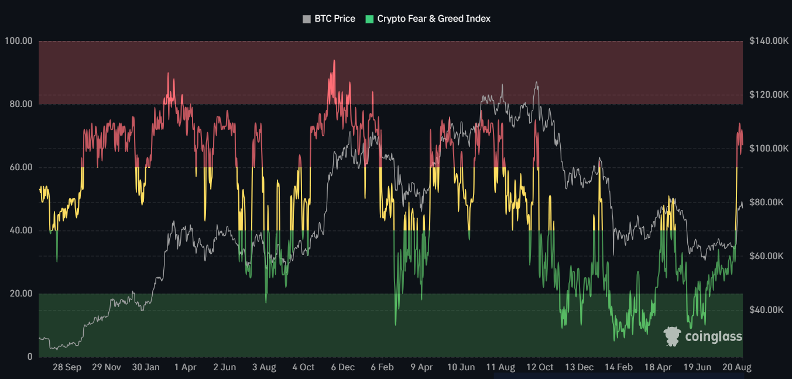
Source: Coinglass, as of 31 August 2026. For reference only, does not constitute any investment recommendation.
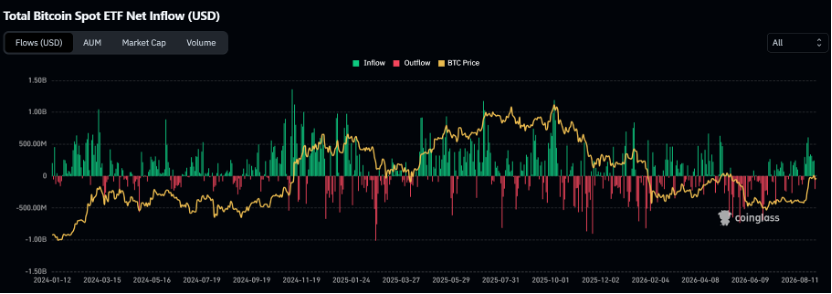
Bitcoin spot ETF flows were mixed but showed signs of improvement in August 2026. Although intermittent outflows persisted during the month, positive net inflow days became more evident toward the end of August, coinciding with Bitcoin’s price recovery. The renewed inflows suggest that institutional investors selectively increased exposure to Bitcoin through regulated spot ETF products as market sentiment strengthened, while the continued volatility in daily flows indicates that investor positioning remained cautious and responsive to short-term market conditions.
Figure 6. Total BTC Spot ETFs Net Inflow
Source: Coinglass, as of 31 August 2026. For reference only, does not constitute any investment recommendation.
Market Performance Overview
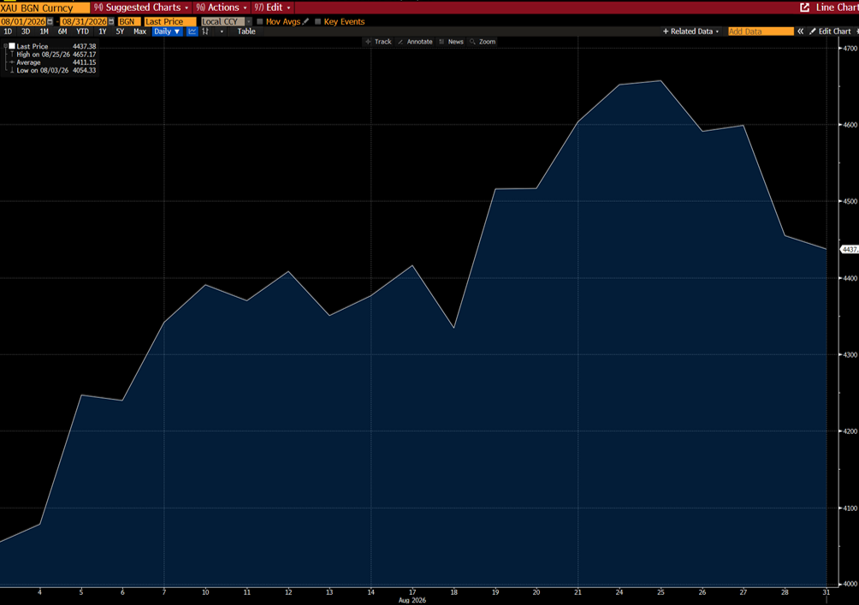
Gold prices rose strongly through most of August 2026, climbing from around US$4,050 per ounce at the start of the month to a peak near US$4,650–4,660 per ounce on 24–25 August. The rally reflected sustained investor demand for safe-haven assets amid heightened uncertainty surrounding inflation, interest rates and broader macroeconomic conditions. Prices subsequently retraced in the final week of the month, falling back toward US$4,440 per ounce, but still ended August materially above the opening level. Overall, the month’s performance demonstrated continued resilience in gold demand, although the late-month pullback suggests some profit-taking following the sharp mid-month advance.
Figure 7. Gold price change
Source: Bloomberg as of 31 August 2026. Investment involves risks. Past performance does not represent future performance.
Outlook
Against this macro backdrop, both crypto assets and gold demonstrated resilience in August. Bitcoin and Ether recorded strong late-month gains, supported by improving risk sentiment, renewed institutional participation through spot ETF flows and a softer US dollar. Gold also advanced sharply during the month, benefiting from safe-haven demand and investor concerns over persistent inflation, fiscal pressures and elevated long-term bond yields, before experiencing some profit-taking near month-end. Overall, the concurrent strength in gold and digital assets reflected investor demand for alternative stores of value amid uncertainty over the interest-rate outlook, government debt dynamics and geopolitical risks; however, both asset classes remain vulnerable to short-term volatility should US inflation data or Fed policy expectations become more hawkish.
This material is produced by MicroBit Capital Management Limited ("MicroBit") and is intended for Hong Kong investors only. All content is for general information purposes and does not constitute an offer, solicitation, or recommendation to buy or sell any financial instruments, nor is it legal, financial, tax, or investment advice.
Investments involve risks. The value of investments can go up or down, and investors may lose some or all of their invested capital. Past performance is not a guarantee of future results. You should carefully consider your investment objectives and risk tolerance and seek advice from a professional financial advisor before making any investment decisions.
MicroBit does not guarantee the accuracy, timeliness, completeness, or reliability of the information provided. All materials are presented “as is”, without any warranties of any kind, whether express or implied, including but not limited to merchantability, fitness for a particular purpose, or non-infringement. Unless otherwise specified, some of the views and recommendations are compiled by MicroBit based on publicly available data and market experience.
Securities and Futures Commission (SFC) authorization is not a recommendation or endorsement of a scheme, nor does it guarantee its commercial merits or performance. This material has not been reviewed by the SFC.
Copyright © 2026 MicroBit Capital Management Limited. All rights reserved.